
Addressing Climate Change
Climate Change Governance
Climate-related governance at Korean Re is led by the ESG Committee, with oversight provided by the board and executive management, who are responsible for decision-making on climate risk management.
█ Climate Change Governance
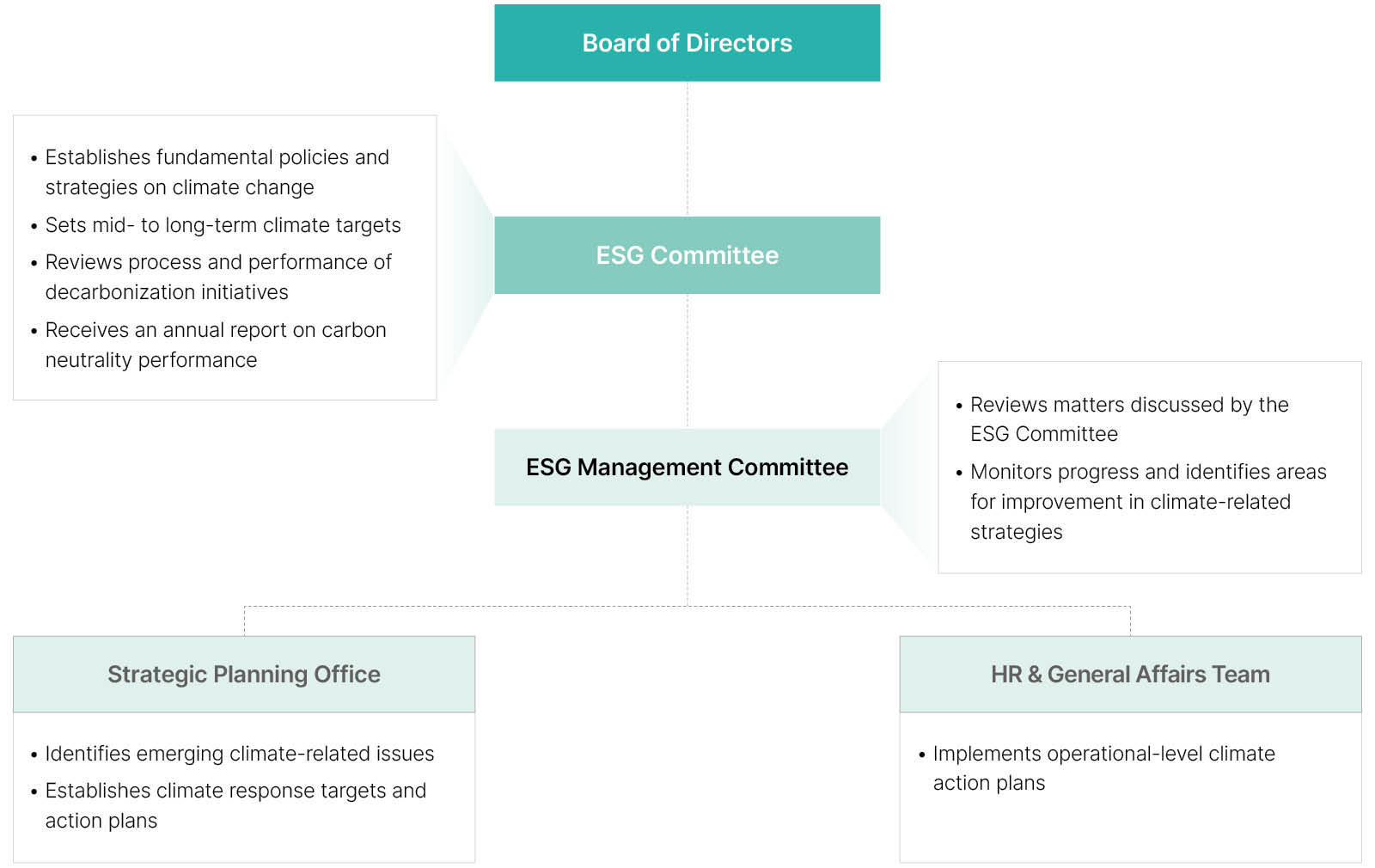
Responding to Climate Change
Declaration on the Phase-Out of Coal Financing
There are increasing demands for responsible investment by financial institutions. For the insurance industry, in particular, underwriting and managing assets with internalized ESG factors are becoming increasingly important.
In November 2022, Korean Re declared its intention to phase out coal financing, following a resolution by the ESG Committee. This initiative aims to contribute to the transition to a carbon-neutral economic system as a global reinsurer and internalize ESG factors across our management practices.
We are committed to achieving net-zero carbon emissions by 2050 through phasing out coal financing and setting eco-friendly underwriting and investment goals.
Responsible Investment Standards
In May 2023, Korean Re established the Responsible Investment Standards to recognize its social responsibility and impact on sustainability and to strengthen its asset management policies related to the coal phase-out declaration and carbon neutrality goals as part of its active participation in the 2015 Paris Agreement. The standards contain a set of principles that should be applied from the stage of the identification and proposal of businesses and projects to the final deliberation and resolution.
• ESG Investment Criteria and Process
Korean Re bases its investments on socially responsible investment (SRI*) criteria. We allocate funds raised through the issuance of sustainable bonds to areas with clear ESG advancement objectives, such as renewable energy. In the process of making investment decisions regarding stocks, bonds, and other securities, we prioritize companies demonstrating outstanding ESG performance. Additionally, we strive to reduce the net greenhouse gas emissions from our investment portfolio in line with our 2050 Net-Zero goals.
• Investment Restrictions and Exceptions
Korean Re proactively reviews and restricts investments in companies and industries that negatively impact the environment and society. We gradually limit investments in the following areas, and we regularly update our investment restrictions list for certain listed companies and bond issuers as necessary:
• Coal mining and coal-fired power plant construction
• Tar sands, Arctic, and deep-sea oil and gas
• Other companies and industries deemed not to be in support of social responsibility
However, exceptions may be considered for special purpose bonds and funds that align with ESG objectives or for investments in socially necessary areas, such as national energy policies, support for the socially disadvantaged, and assistance to underdeveloped countries. In such cases, prior coordination with the Manager of Sustainability & Corporate Affairs is required to minimize social and environmental risks associated with any investments.
CAT Modeling
To effectively manage catastrophe risk, one of the major physical risks for our company, we have an organizational unit dedicated to CAT modeling that consists of experts in natural disaster risks. The team utilizes leading industry CAT models, including RMS (by Moody’s) and AIR (by Verisk), to conduct in-depth analyses of natural disaster risks such as typhoons. These models support continuous monitoring to ensure that financial losses arising from climate risks remain within Korean Re’s established risk tolerance thresholds. Based on the analyses, Korean Re has developed proprietary optimization tools for portfolio adjustment and profitability analysis, further enhancing its overall catastrophe risk management capabilities.
To address the growing risks associated with nonpeak perils driven by climate change, we are also strengthening our risk management measures, including the implementation of an updated hazard map system.
* Socially Responsible Investment (SRI): A financial activity that invests in companies based on a wide range of performance metrics, including human rights, environment, labor, and community contributions, in addition to financial performance.
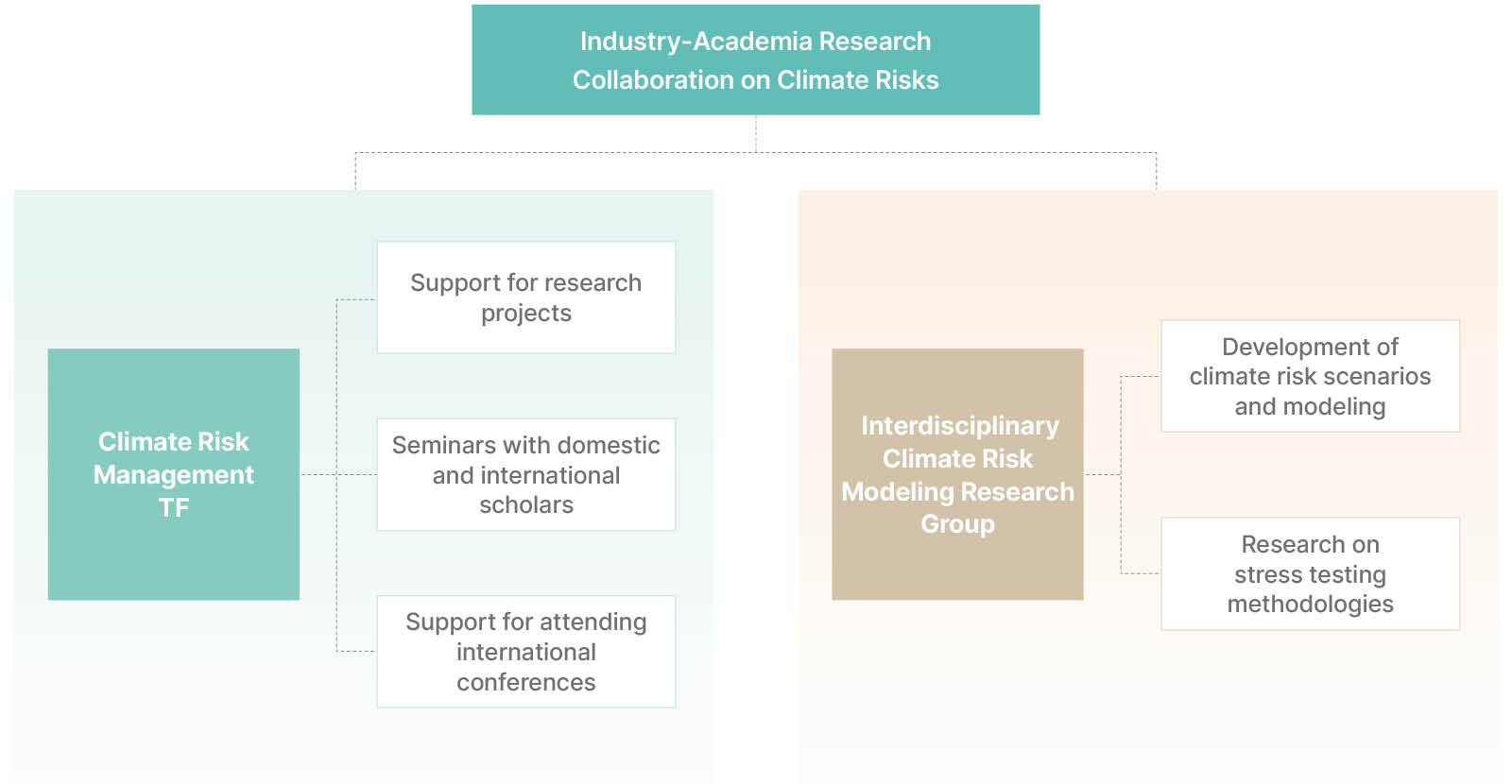
Industry-Academia Research Collaboration on Climate Risks
Korean Re actively engages in collaborative research and seminars with academic institutions to proactively address the risks and opportunities posed by climate change. Through these efforts, we aim to foster industry-wide dialogue on climate risk response strategies and to reinforce our role as a leading voice in the insurance and reinsurance sectors.
• Climate Risk Management Task Force
Korean Re operates a Climate Risk Management Task Force (TF) in collaboration with the Korea Risk Management Society, enhancing its climate action capabilities by actively sharing its expert knowledge and insights on the climate crisis with both academia and industry.
The Climate Risk Management TF expands the scope of climate crisis research by integrating disciplines such as insurance, climate science, meteorology, and engineering. Today, it continues to support academic studies by providing a platform for emerging researchers.
• Interdisciplinary Climate Risk Modeling Research Group
Increasing extreme weather events impact economic systems in the form of physical and transitional risks. Therefore, precisely predicting potential climate risks and modeling their financial and insurance impacts is essential to the insurance business. To address this, Korean Re has formed an Interdisciplinary Climate Risk Modeling Research Group in collaboration with leading university researchers. Together, they are developing an integrated climate risk management model that incorporates future climate change impacts into our existing CAT models. This initiative ultimately aims to establish a more advanced climate risk management framework.
The research comprises three stages: climate change scenario development, climate risk quantification, and financial and insurance impact analysis. Each research area is sequentially and interdependently linked. In addition, we have hosted industry-academia research seminars on each of these research stages to share knowledge and discuss response strategies with industry and academic stakeholders.